City Deal On AI
In the City Deal on AI, participating governments, knowledge institutions, social organizations, and companies agree to establish an intergovernmental and public-private partnership focused on the responsible and effective use of Artificial Intelligence (AI) for societal challenges related to the quality of life in cities and towns.
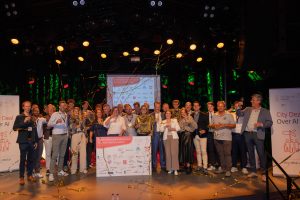
If you’re interested in the AI City Deal contact Jan-Willem Wesselink of ELBA\REC (at [email protected]) or call +31338700100 and ask for Jan-Willem. The City Deal was signed on September 18th during the AI in the City Congress in Breda.
The parties aim to learn, develop, apply, and embed together. They will achieve this through a shared structure consisting of an AI-Workplace, a Knowledge Network, and concrete projects. They will do this while respecting the public values of safety; justice; well-being and autonomy; sustainability and prosperity; and local identity. By leveraging each other’s expertise, sharing mistakes and successes, jointly investing in knowledge and capacity, and learning from experiences at home and abroad, the parties are building an agile and future-proof public sector that uses AI with a focus on people, society, and democratic values.
Who is participating?
The following parties have signed the City Deal: The Ministry of the Interior and Kingdom Relations, The Ministry of Housing and Spatial Planning, Municipality of Apeldoorn, Municipality of Breda, Municipality of Den Haag, Municipality of ‘s-Hertogenbosch, Municipality of Rotterdam, Municipality of Sittard-Geleen, TNO, Argaleo, Dembrane, ELBA\REC, ESRI Nederland, Goudappel, KPN, Starling Associates, TwijnstraGudde, DMI-ecosystem, De Kien, De Friese Aanpak, EIT Urban Mobility, Rotterdam University of Applied Sciences, Amsterdam University of Applied SciencesHogeschool , NHL Stenden University of Applied Sciences , TU Delft, GovTech NL, Post-X Society, Platform31, Platform AI & Overheid, PRIO, Waag Futurelab.
What’s it about? – The societal question
Two out of three Dutch people live in cities, and that number is growing. Governments must accommodate this growth while maintaining livability. This is challenging due to housing construction pressure, nitrogen and grid congestion issues, limited space, staff shortages, and the need for energy transition and climate adaptation. Socially, the gap between rich and poor is also widening, and work is rapidly changing due to digitalization. Businesses and governments are searching for ways to keep up, while communication between government and residents is under pressure.
AI as an opportunity
Artificial intelligence can help solve urban challenges. AI can analyze large amounts of data, supporting governments in better policy, decision-making, and implementation. However, the knowledge and capacity to effectively apply AI are often lacking. Therefore, roles and skills need to be adapted, and it must be clarified how AI can concretely contribute to societal goals.
Prerequisites
The City Deal states that AI must be developed safely, fairly, sustainably, and people-focused. Applications must respect public values: safety, justice, well-being, autonomy, sustainability, prosperity, and local identity. Cities remain unique; AI must not lead to uniformity. Public AI must also be developed—future-proof, independent, and sovereign—alongside private applications.
Shared Promise
The participating governments, knowledge institutions, businesses, and civil society organizations will learn together to use AI responsibly for livable cities and towns. They will explore the demands this places on their own organizations and learn from each other.
Structure of the City Deal
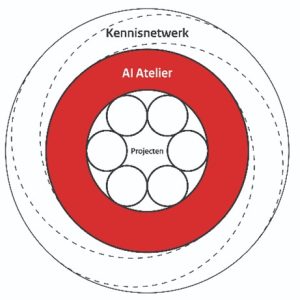
The collaboration rests on three pillars:
- Projects – applying AI solutions to societal challenges;
- AI-Atelier – a collaborative workshop for process innovation with AI;
- Knowledge Network – a platform for sharing insights, knowledge, and standards.
Together, these components form an ecosystem in which learning, innovation, and implementation are interconnected.
Embedding
The acquired knowledge and developed products are embedded through networks such as the AI and Government Platform and the DMI-ecosystem, ensuring the results are shared and further developed sustainably.